
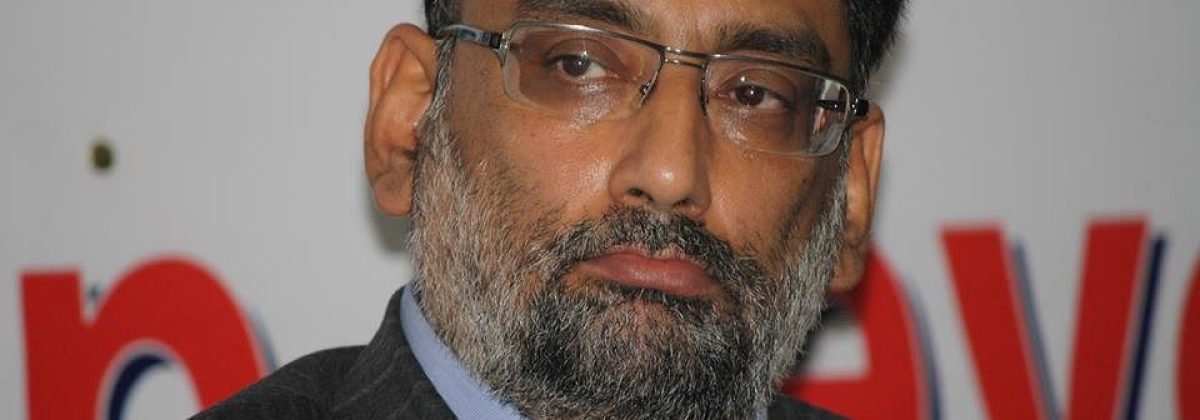
Former Finance Minister says assembly elections ‘exposed deepening religious, regional divides’; believes statehood for erstwhile State unlikely for next five years, cites structural overhaul, administrative & legal hurdles
Srinagar, Dec 05: “Jammu and Kashmir may be heading toward further bifurcation due to the deepening religious and regional divide between the two divisions,” former Finance Minister of the erstwhile State, Haseeb Drabu believes.
He said the recent assembly elections have “exposed a clear communal divide”. “Jammu voted one way, and Kashmir another,” Drabu, according to the news agency—Kashmir News Observer (KNO), said while speaking at a panel discussion on J&K polls.
He described the state as “unnatural”, with no shared language, culture or politics between its two regions – Kashmir and Jammu.
“Jammu and Kashmir regions have historically been held together by its politics, but even that glue is now impaired,” Drabu said, adding that the August 2019 reorganisation could have been a stepping stone to splitting the state further into two separate entities.
“This is the first election which has not been fought on ideology but on religion. And that is a concern. To my mind, the biggest message coming out of this election is that we are not very far from having to split the state into two,” he added.
Haseeb Drabu also asserted that Jammu and Kashmir will not regain statehood for at least five years. “This delay is due to the extensive changes in administrative, legal and institutional structures following the abrogation of Article 370 and the bifurcation of the state in August 2019,” he said.
He said that restoring statehood is not as simple as a presidential decision. “You have to unwind it. Numerous laws, statutes, and acts have been changed. The administrative structure has been altered, and the civil services are no longer the same. The Jammu and Kashmir cadre has been merged into a larger central cadre. Unwinding this will take years,” he said.
Drabu, who played an instrumental role in forging the alliance between the People’s Democratic Party (PDP) and the Bharatiya Janata Party (BJP) in 2014, explained: “Let me tell you, here and now, there is no statehood that is going to come for the next five years. Why would there be any statehood? And do you realise, it is not that you wake up one day and say, alright, now I convert J&K into a state. No. You have to unwind it. Do you realise how many laws, statutes, and acts have been changed? The administrative structure has been changed. The civil services have been changed. It will have to be unwound over a number of years depending on how the situation evolves. It is not something that the President of India wakes up one day and does. So, let’s not shift from that perspective. I think we need to understand that there are multiple realities, and we need to see each of them and how that impacts the situation going forward in J&K.”
Acknowledging the smooth conduct of the elections, Drabu criticised the pre-poll processes, particularly the delimitation exercise. “The delimitation was unprecedented and done under the Reorganisation Act of 2019 instead of the usual People’s Representation Act. It was a gerrymandering of constituencies, especially in regions like Chenab Valley, designed to structurally constrain the results,” he said.
Drabu dismissed claims that the elections reflected an endorsement or resentment of the abrogation of Article 370. “Choose your narrative,” he quipped, adding that the elections reflect the fractured political and social realities of Jammu and Kashmir.
He was critical of the development narrative surrounding Article 370. “There is no evidence that the removal of Article 370 has brought significant investment or economic progress to J&K. If anything, the region was better off economically and socially than the rest of India before 370’s abrogation,” he argued.
The economist also talked about the symbolic nature of Article 370 in recent years. “What was there to abrogate? By the 1960s, most of its provisions had been eroded. Its removal was more about setting a political narrative than bringing any tangible change to the region,” Drabu said. “The region’s tragedy lies in its shift from an inclusive political identity to one deeply divided along religious and regional lines. The promise of integration has instead delivered polarisation.”